Yrr collective intelligence
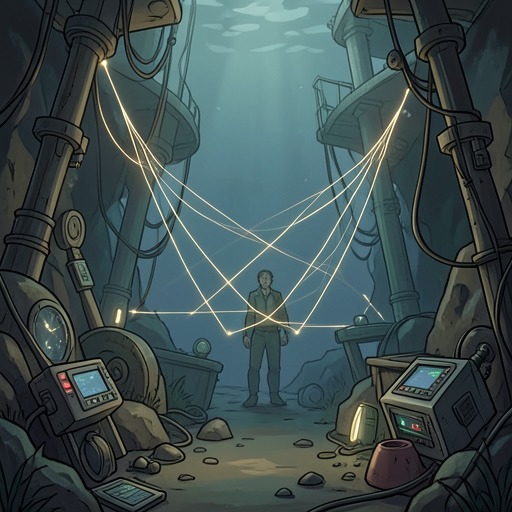
The SwarmYrr collective intelligence is the capacity of Yrr cells to form larger cognitive wholes: individual cells gather, exchange and revise information, and act as parts of a collective whose abilities exceed those of any one cell. The novel develops this idea from the visible aggregation of a jelly-like mass into a theory of learning and inherited memory. Intelligence is not located in a single brain or leader; it emerges through connections among cells and persists through the collective’s biology.
From chemical signal to collective
The first explanatory step is aggregation. Sue Oliviera compares the phenomenon with the behavior of Myxococcus xanthus, soil-dwelling bacteria that move in loose swarms. When an individual cannot find enough nutrients, it releases a chemical starvation signal. As more cells experience starvation, the signal strengthens; once it crosses a threshold, the swarm draws together and forms a multicellular fruiting body. The example offers a known model for how separate cells can coordinate without a central command.
In the novel’s account, the Yrr also use a chemical signal to bring cells together. Karen Weaver describes the substance as a pheromone, and the team finds that its formula is simple enough to synthesize. Because chemical molecules disperse rapidly underwater, this signaling is suited to short-range communication. It appears to serve a limited but essential purpose: summoning free-floating amoebas into an aggregate. The scientists do not establish exactly what initiates aggregation or how communication continues after the cells have joined. Their explanation therefore distinguishes the known function of the signal from the larger cognitive process that remains uncertain.
When Yrr material aggregates on a much larger scale, the result makes that question tangible. Sigur Johanson observes a mass formed from amoebas with no apparent eyes, ears, heart, brain, or gut, yet capable of complex processes. The cells cluster and harden into a coherent form; when Johanson brings a sampling robot close, the mass captures it and settles. The episode presents organization itself as evidence of capability: a being without familiar sensory or neural organs can still behave as an integrated, responsive entity.
A computer model of learning
The research team tries to test how such an entity might think by building virtual amoebas. Leon Anawak and Karen Weaver describe a model in which electronic cells carry DNA that continually mutates. Their earlier attempt to divide a neural-network computer into its smallest programmable units and reassemble it as a thinking whole had failed. In the new model, learning by the individual units changes the outcome: the cells can develop as a functioning network. A scent provides the simulated signal for aggregation, while movement through three-dimensional space introduces conditions intended to resemble the deep sea, including pressure, currents, and friction.
The researchers also need to account for recognition: cells must distinguish members of their own collective from others. They propose that small, hypervariable sections of Yrr DNA serve as a code. In their simulation, cells with matching codes aggregate first. Yet the model does not stop at keeping groups separate. When two collectives with different codes are brought together, they exchange their coding and update one another, adopting a shared standard. The merged collective can then join with a third, with each merger producing a new state of knowledge.
A test involving a simulated shark makes the model’s account of learning more concrete. One collective is given information about an attack and shown how to evade it; another is not taught and is bitten. Once the two collectives aggregate, the combined mass avoids the shark. When that mass is divided into smaller groups, each group retains the learned response. In the model, experience is not confined to the cells that first acquired it: aggregation makes it available to the larger whole, and division carries it onward.
Scale, adaptation, and emergent behavior
The team’s simulations suggest that Yrr collectives can think at the speed of advanced parallel processors. Their account is not that every collective automatically solves every problem. Some are unable to handle new challenges in isolation, but aggregation lets them learn. At first, the learning curve appears linear; beyond a threshold, however, behavior becomes difficult to predict. The researchers find that more complex problems prompt more frequent aggregation, and that the simulated amoebas begin developing strategies that were not programmed into them. The model’s learning becomes creative rather than merely repetitive.
In their tests, the electronic Yrr can assume forms, imitate and vary the shapes of other living things, and use feelers to examine objects at a scale finer than human touch can manage. Information acquired by one cell is shared throughout the collective. The team characterizes the resulting organism as an enormous variable brain, with the ability to respond rapidly to its surroundings. They also acknowledge limits to their conclusions: the tests are few, the system is a computer program, and the inferences rest on a model rather than direct access to Yrr thought. Nevertheless, the simulation gives a proposed mechanism for the rapid responses associated with the mass that attacked the well deck of the USS Independence.
Genetic memory and the collective self
The most consequential extension of the theory is the claim that Yrr DNA stores knowledge. Sigur Johanson proposes that the Yrr may have become conscious as early as the Jurassic era and accumulated information ever since. In humans, experience does not pass directly from a dead person’s mind to a newborn’s; societies preserve parts of the past through words, written accounts, and images, while every individual begins without the lived memories of earlier generations. In Johanson’s account, a Yrr cell duplicates its genome when it divides, passing stored information into its descendants. New cells therefore inherit not just abstract instructions but what the novel describes as real experience.
This inherited record changes the balance between individual death and collective survival. Johanson warns that destroying a single collective may not be enough to erase its knowledge: cellular networks may extend for hundreds of kilometres, and the surviving cells retain what the larger network has learned. The collective can compare outcomes, refine strategies, and preserve innovations over time. Its knowledge is not held in a specialist institution or entrusted to a leader; it is distributed among cells and carried forward through reproduction and aggregation.
The scientists do not conclude that every amoeba has a human-like individual consciousness. Anawak instead describes individual cells as sensors that turn experience into usable information and feed it into the collective. A thought may influence the whole only when its impulse is strong enough, or when enough cells introduce it at once; competing possibilities are weighed, and the fittest survives. Weaver likens this process to natural selection. Collective intelligence thus joins sensation, information exchange, and selection without requiring the familiar human separation between an individual mind and a social body.
Human limits and narrative significance
The theory unsettles human measures of intelligence. The research team initially struggles with the possibility that single-cell organisms could think, since prevailing assumptions associate intelligence with a sufficiently large brain. Yrr cognition instead depends on many cells acting together, and the collective’s memory can outlast any one cell. Its apparent advantage is not simply speed: knowledge can persist without written records, and no single member needs to contain the whole.
That contrast also makes the concept unsettling. Humans rely on individuals and institutions to preserve knowledge, yet those records do not give later generations the experience itself. The Yrr model links body and mind at the level of the collective: cells participate in acquiring and passing on information, while the collective’s actions serve its continued existence. The novel leaves open precisely how the cells communicate after aggregation and whether a queen initiates collective action. Those unanswered questions prevent the theory from becoming a complete account, but sharpen its central shift in perspective: intelligence need not resemble a human mind to organize experience, learn from it, and act.